

the architecture of trust | musing no. 90
you didn't lose it all at once.

new to cuffed? start here.
the architecture of control: a 9-week dissection of how manipulation works — how it starts, how it hides, and why it’s so hard to name while it’s happening.
musing no. 74 → musing no. 75 → musing no. 76 → musing no. 77 → musing no. 78 → musing no. 79 → musing no. 80 → musing no. 81 → musing no. 82 → musing no. 83 → musing no. 84 → musing no. 85 → musing no. 86 → musing no. 87 → musing no. 88 → musing no. 89
avoidance + ghosting + boundaries: what disappearing actually means — and what it costs the person left waiting.
musing no. 68 → musing no. 69 → musing no. 70 → musing no. 71 → musing no. 72 → musing no. 73
the podcast is the raw intimate audio layer
that adds depth to the long-form content.
subscribe and follow wherever you listen
to your podcasts.
—
i spent eighteen musings
teaching you how to recognize
when trust is being destroyed.
the patterns.
the tactics.
the slow erosion that happens
before you have language for it.
i taught you what damage looks like
from the outside.
what i didn’t tell you —
is that i know what it looks like
from the inside.
because i was the one causing it.
—
the control and manipulation arc gave me
something i didn’t expect.
a mirror.
not pointed outward at the patterns
i was naming for you.
pointed inward.
at the ones i was living.
and what i saw
required me to stop pointing outward
and turn the lens around.
—
here’s what i know now.
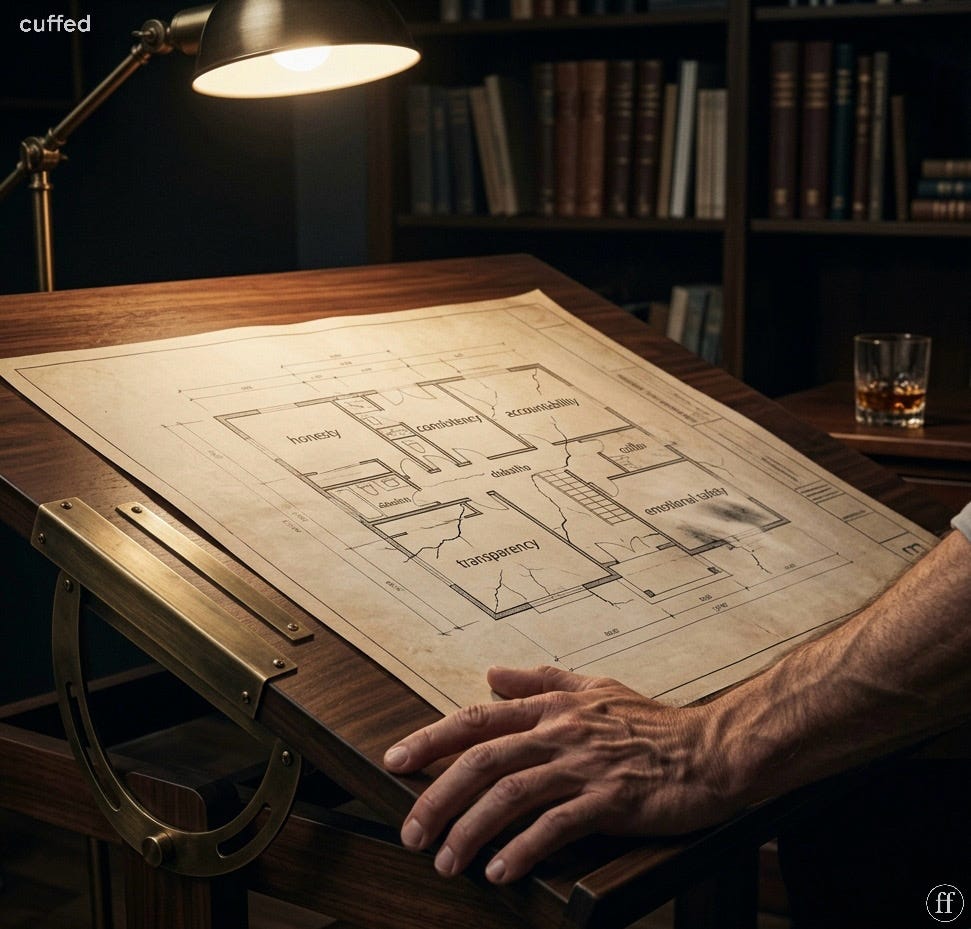
trust is not a feeling.
it’s a structure.
and like any structure —
it isn’t built or destroyed in a single moment.
it is built component by component.
maintained component by component.
and broken
the same way.
—
i know this
not because i studied it.
but because i felt it leave.
quietly.
in increments.
one unanswered moment at a time.
and i was the one
taking it apart.
—
there are eight components.
honesty.
intellectual honesty.
reliability.
consistency.
emotional safety.
accountability.
transparency.
follow-through on repair.
each one is a load-bearing wall.
when one fails —
the whole structure becomes unstable.
you might not notice immediately.
the building stays standing.
you keep living inside it.
but the cracks were always there.
and the feeling of betrayal —
that sudden collapse you couldn’t explain —
that wasn’t the beginning.
that was just the moment
the damage finally became
impossible to ignore.
—
over the next five weeks
we go room by room.
one component per musing.
not as theory.
not as a list of things to look for
in someone else.
but as a mirror.
because the most important question
in this arc
isn’t whether someone is doing this to you.
it’s whether you’ve ever done this
to someone who deserved better.
i have.
—
her name is dabatha.
she stood by me without ever wavering.
she pulled me closer on valentine’s day
when someone else’s chaos
tried to pull us apart.
she chose me consistently
when it wasn’t easy for her.
and i failed her
on almost every component
that matters.
i know exactly what i broke.
i know which wall came down first.
—
this arc exists because of what
i finally understood.
and what it cost someone
who deserved better.
that’s where we begin.
hold the standard.
and stay close.
— author
———
the red room directive no. 29
is where the diagnostic lives.
eight components mapped.
the audit.
the pattern questions.
the repair test.
and the one question that tells you
whether what you have is fixable —
or whether you’ve been alone
longer than you realized.
if you’ve been sitting with a feeling
you can’t quite name —
that’s where you’ll find the language.
subscribe for full access. ↓
—
p.s. the cuffed store is open. prints. digital downloads. coaching.
—
p.p.s. next week we go into the first room.
honesty.
not the easy kind.
subscribe so you don’t come in mid-turn. ↓