

the architecture of self | musing no. 101
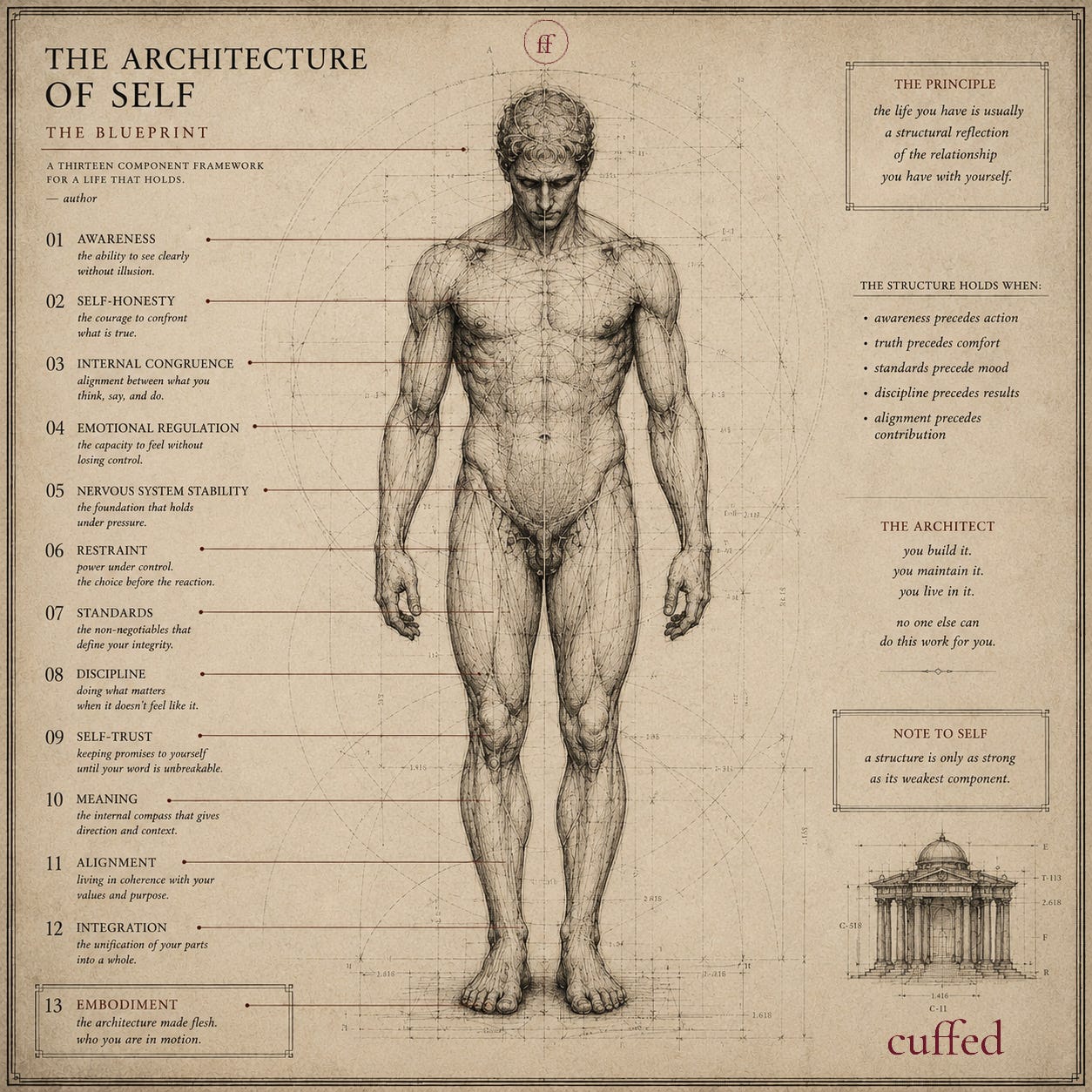
the blueprint — a thirteen component framework for a life that holds

—
the architecture of trust: musing no. 90 → musing no. 91 → musing no. 92 → musing no. 93 → musing no. 94 → musing no. 95 → musing no. 96 → musing no. 97 → musing no. 98 → musing no. 99
the architecture of control: musing no. 74 → musing no. 75 → musing no. 76 → musing no. 77 → musing no. 78 → musing no. 79 → musing no. 80 → musing no. 81 → musing no. 82 → musing no. 83 → musing no. 84 → musing no. 85 → musing no. 86 → musing no. 87 → musing no. 88 → musing no. 89
—
and lastly, the podcasts are the raw intimate audio layer that adds depth to the long-form content. subscribe and follow wherever you listen to your podcasts.
—
there is a question underneath every musing in the last arc.
it wasn’t the question i was asking out loud.
i was asking about trust.
about consistency.
about why men go silent when the relationship needs them most.
about why accountability feels like an attack
to someone who was never taught to hold himself.
but underneath all of it,
the real question was forming.
quietly.
the way structural damage forms.
before the crack appears.
the question was:
where does all of it come from.
—
not the behavior.
not the pattern.
not the avoidance or the manipulation or the covert contract
or the man who gives just enough to keep you uncertain.
underneath all of that —
where does all of it come from.
—
the answer isn’t complicated.
but it is confronting.
it comes from the relationship he has with himself.
not his relationship with you.
not his relationship with his father.
not his history, his trauma, his attachment style —
those are context.
the source is simpler and harder than all of that.
it’s the relationship he has with himself.
and most men have never looked at it directly.
—
the life you have
is usually a structural reflection
of the relationship you have with yourself.
your relationships.
your career.
your sense of identity.
your ability to hold a standard
when no one is enforcing it.
all of it reflects the internal structure
you either built
or never did.
—
this is not about self-improvement.
self-improvement assumes the structure is sound
and just needs updating.
this is about architecture.
architecture asks a different question:
what kind of internal structure
is capable of sustaining a real life —
a real relationship,
a real purpose,
a real identity —
without collapsing under pressure.
—
that is what this arc is about.
these are not qualities to aspire to.
they are the walls.
awareness.
self-honesty.
internal congruence.
emotional regulation.
nervous system stability.
restraint.
standards.
discipline.
self-trust.
meaning.
alignment.
integration.
and the capstone:
embodiment.
—
none of them are optional.
because a structure doesn’t get to choose
which load-bearing wall it keeps.
—
author’s note
i didn’t come to this arc from theory.
i came to it from a specific moment —
after everything with dabatha fell apart —
when i finally stopped asking
what went wrong between us
and started asking
what was already broken in me.
that was the harder question.
it was also the only useful one.
i had spent months writing about avoidance.
about manipulation.
about the architecture of trust.
and somewhere in that process,
writing earned at the same time,
it became impossible to ignore
what was sitting underneath all of it.
every pattern i was naming in other men —
i had to ask:
where have i done this.
where am i still doing this.
and more importantly:
why.
the answer, every time,
came back to the same place.
not the relationship.
not the circumstances.
not her.
the relationship i had with myself.
once i saw that —
i couldn’t unsee it.
and i knew that whatever i built next
had to start there.
not with better communication strategies.
not with attachment theory frameworks.
not with the right partner.
with the foundation.
this arc is that foundation.
i hope you build something that holds.
— author
—
—
p.s. the cuffed store is open. prints. digital downloads. coaching.
p.p.s. next: musing 102 — awareness. the blueprint only works if you can read it accurately. subscribe so you don’t come in mid-turn. [subscribe]
p.p.p.s. <3 you cg.