

the architecture of intimacy. | musing no. 129
i thought intimacy was two doors. it took a decade — and one woman who kept trying to tell me — to find out it's a building.

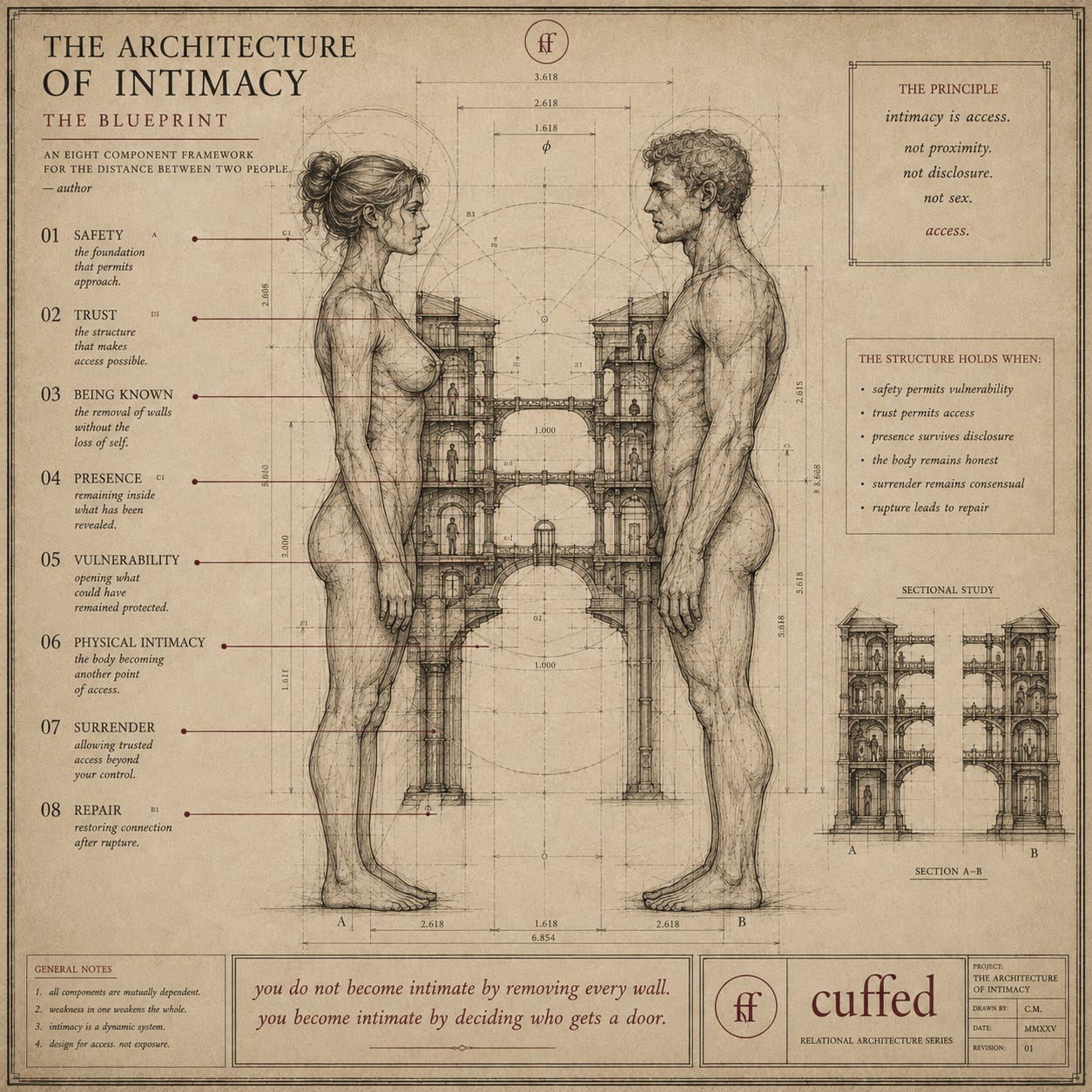
—
the architecture of self → musing no. 101
the architecture of trust → musing no. 90
the architecture of control → musing no. 74
—
and lastly, the podcasts are the raw intimate audio layer that adds depth to the long-form content. subscribe and follow wherever you listen to your podcasts.
—
i used to think intimacy had two doors.
the first was emotional.
you knew someone.
really knew them.
you talked about everything. you didn’t hold anything back. you knew what they were afraid of, what they wanted, what had happened to them, what they regretted.
the second door was physical.
access to her body.
sex. touch. nakedness. the things we tend to call intimate because they happen behind closed doors.
—
that was pretty much my entire definition.
know me.
let me know you.
let me touch you.
intimacy.
it took me more than a year of working on cuffed—and more than a year after my breakup—to realize how incomplete that definition was.
—
what makes that realization even stranger is that someone had already tried to explain it to me.
i just didn’t understand what she was saying.
the russian used to tell me that she couldn’t develop feelings for someone until she felt safe and stable.
she was very clear about it.
safety.
stability.
at the time, i heard those words as requirements specific to her.
something she needed.
almost like everyone has their own checklist before they can let someone in, and those happened to be two things on hers.
—
i understand it differently now.
she was explaining intimacy to me.
i thought she was explaining herself.
she wasn’t asking for two things before intimacy could begin.
for her, those things were part of intimacy.
they were what made everything else possible.
and that’s where my two-door definition started falling apart.
because you can know an enormous amount about someone without making them feel safe.
you can talk for hours without being present.
you can disclose everything about yourself without actually being vulnerable.
you can have access to someone’s body without having access to them.
you can have sex without surrender.
you can love someone and still not know how to repair what happens when one of you gets hurt.
—
proximity isn’t intimacy.
information isn’t intimacy.
and sex isn’t intimacy simply because you’re naked.
those things can be expressions of intimacy.
but none of them, by themselves, are the structure.
most people never find this out on purpose.
they find out by accident.
mid-relationship.
mid-collapse.
staring at someone they’ve known for years,
realizing they never actually knew
which parts of the building were missing.
by then it’s not a musing.
it’s a post-mortem.
—
the mechanism — which of these eight components
you’re actually missing, and what it’s quietly
costing you right now — is inside rr.67.
not next month.
not “eventually.”
now, while you can still do something
with the answer.
—
that distinction took me a long time to understand.
i thought intimacy was a room.
it turns out it’s the entire building.
and like every structure we’ve explored through cuffed, it has components.
some carry weight.
some create access.
some protect what’s inside.
some determine whether another person is ever allowed through the door.
—
for this series, i’ve broken that architecture into eight components.
safety.
not a mood. the ground you build on.
trust.
not a feeling. the structure that makes access possible.
being known.
what exists behind the version of you everyone else gets.
presence.
staying, once something real has been revealed.
vulnerability.
opening what you could have kept protected.
physical intimacy.
the body becoming another place where access and trust and exposure meet.
surrender.
going further in without losing yourself on the way.
repair.
what intimacy does after it breaks.
—
none of these exist completely independently of the others.
safety affects vulnerability.
trust affects surrender.
presence affects whether being known feels safe.
physical intimacy can require all of them.
repair determines whether access remains possible after something breaks.
and different people need different parts of the structure to carry more weight.
—
the russian told me safety and stability were paramount for her.
i didn’t need to correct that.
i needed to understand what she was telling me.
her experience was the blueprint.
i just didn’t know how to read it yet.
it isn’t how much someone lets you know.
it isn’t how much someone tells you.
it isn’t how much of their body they give you.
it’s what becomes possible between two people when enough of the structure exists to support access.
because access without safety can feel invasive.
access without trust can feel dangerous.
being known without presence can feel exposing.
physical intimacy without connection can still leave two people profoundly alone.
and surrender without the architecture underneath it isn’t intimacy at all.
—
so we’re going to take it apart.
piece by piece.
not because intimacy should feel mechanical.
because something this important deserves more than the two doors i spent most of my life believing were the entire building.
and when we’re done, there’s one final question left.
whether understanding the architecture actually changes the way we live inside it.
because eventually intimacy has to stop being something we can explain.
it has to become something we can hold.
— author
p.s. the cuffed shop —
books. prints. music. coaching.
p.p.s. the architecture of intimacy has officially launched.
subscribe so you do not miss a single word.
this isn’t the only thing we made.